IONOSPHERE
A consciousness-RNG field program: what true randomness looks like across multiple field conditions, the QA that caught our own false positive, and the exploratory attention-window effects that survived it.
If there is a measurable consciousness-RNG signal, it should show up not as drift in the mean of the bitstream but as anomalous bursts concentrating during windows of active engagement. We test that as a window-versus-baseline burst enrichment, hold the whole corpus to a locked battery of clustering tests, and run it against a control RNG nobody is attending. To date the corpus is aggregate-null with no endogenous temporal clustering; what survives is a pair of exploratory window effects, described below.
The question
Ionosphere asks a narrow, falsifiable question: when an audience is engaged with an immersive audiovisual installation driven by a quantum random number generator, does the QRNG output carry more anomalous bursts during windows of active engagement than a parallel RNG nobody is watching -- and does the bitstream hold any endogenous temporal structure (clustering, autocorrelation, cyclicity) that a control lacks?
Most prior consciousness-RNG work has looked for sustained directional drift in the mean of the bitstream [Jahn et al. 1997][Radin & Nelson 1989]. Ionosphere takes a different starting hypothesis: if there is a signal, it manifests as transient burst events during engagement and cancels in aggregate. The mean is not where to look.
That single methodological move -- shifting from mean drift to burst structure -- changes which tests can detect a signal. A two-tailed z-test on the bitsum returns null by design, so the battery instead reads sequential structure (runs, autocorrelation, Markov transitions, spectral cyclicity) and window structure (burst enrichment inside engagement windows). The honest outcome so far: the sequential-structure tests come back null across the corpus, and only the window contrasts hold up -- and only as exploratory results. One dataset that appeared to show strong sequential clustering, NYE 2025/2026, turned out to be a data-duplication artifact; that story is corrected below rather than hidden.
The apparatus
The Ion192 chandelier is the visible end of the system: 192 glass rods with fiber-optic cores arranged in an 8x24 grid, individually addressed by a Raspberry Pi Pico over a single addressable LED chain. The light is the audience's interface to the data.
Behind the chandelier is a pattern engine that translates QRNG output into visible structure. A TrueRNG hardware source [Herrero-Collantes & Garcia-Escartin 2017] produces bits at line rate; every 60 seconds the engine takes a buffer, runs a two-tailed z-test on the bitsum, and uses the resulting p-value as a "glitch factor" between 0 and 1. When the bits look ordinary, the active pattern renders cleanly. When the bits drift away from 50/50, the glitch factor spikes and the pattern distorts -- flicker, interference, stuttered frames. A second statistic from the same buffer (chi-square uniformity across 8 byte-value bins) selects which pattern function runs at all.
The pattern engine is instrumentation, not decoration. It exists to operationalize immersion: if the proposed effect requires audience engagement, then the audience must be engaged with the QRNG itself, not with a screen showing arbitrary visuals. Coupling the visual output to the live statistical state of the bitstream means viewers are watching the data. The patterns are the experimental condition.
A live, browser-rendered version of the pattern engine is available at patterns.html. It uses pseudorandom numbers in the browser rather than a hardware QRNG, but the visual logic is identical to what runs in the field.
The current engine ships 17 user-facing patterns drawing from a 13-palette pool, configurable through three aesthetic profiles (meditation, gallery, social). The chandelier-native _ch192 patterns inject clamped continuous noise that responds to glitch_factor at every magnitude; the older zone-based patterns remain threshold-gated below 0.05. Full catalog -- pattern descriptions, palette swatches, glitch pipeline, aesthetic-profile weights, and apparatus support -- is at patterns.html.
The experiments
Autumn Lights 2025 -- gallery exhibition
October 15-18, 2025. 3,222 one-minute observation periods, ~24.5 MB of raw RNG bytes. Audience: passive, rotating through gallery exhibits. On Friday, two devices ran in parallel -- the main installation in the attended room, plus a hidden 8x8 LED panel running the same code in a side room with no one watching it.
Aggregate result: anomaly rate 4.28%, near the expected 5%, runs test p = 0.969. No clustering at the dataset level. The Friday two-device contrast (327 attended periods vs. 273 hidden periods, unequal N) returned a statistically significant difference on two of three tests:
- Friday main lights (attended): chi-square anomaly rate 7.34%, p = 0.041
- Friday 8x8 panel (hidden): chi-square anomaly rate 4.03%, p = 0.807
- Mann-Whitney U comparison of period-level p-values: p = 0.013
- Fisher's exact test odds ratio: 1.89x attended vs. hidden, p = 0.114 (n.s.)
- Saturday (replicated attended condition): chi-square 8.42%, p = 0.008
Anomalies were elevated in the 20:00 hour, which corresponded to documented peak attendance from gallery sign-in logs. This time window was not pre-specified. (An earlier version of this page also cited a detrended-fluctuation-analysis persistence estimate here; DFA alpha is treated as descriptive only, and its inferential p-value is not trustworthy on these series, so that claim has been withdrawn -- see the note under the battery, below.)
The one exploratory signal Autumn Lights carries is a covariate-window burst enrichment, not endogenous clustering. Field notes place an experienced meditation practitioner at the installation on Friday around the evening's peak z-score (22:23:03, z = 3.31). In the fifteen minutes after that peak, five anomalous bursts occurred versus one in the fifteen minutes before it (binomial P(X≥5) = 0.011). The tightest seven-minute window around the practitioner's presence shows a much larger burst-rate multiple, but on only fourteen periods (p = 0.30) -- a magnitude, not a result, and it should not be read as one. These windows were read off contemporaneous notes, not pre-registered; they are exploratory prioritization for the follow-up, nothing more.
NYE 2025/2026 -- social gathering (blinded contemporaneous control)
December 31, 2025 through January 1, 2026. A second TrueRNG ran in a parallel hidden-control configuration -- empty room, no audience, no awareness, same building, overlapping with the attended device. Attendees were not told the control existed. That was the design point: the first blinded, simultaneous null channel in this program, built to answer the standard critique of prospective RNG-during-event work -- that no comparable RNG was ever running in identical conditions with no event attached.
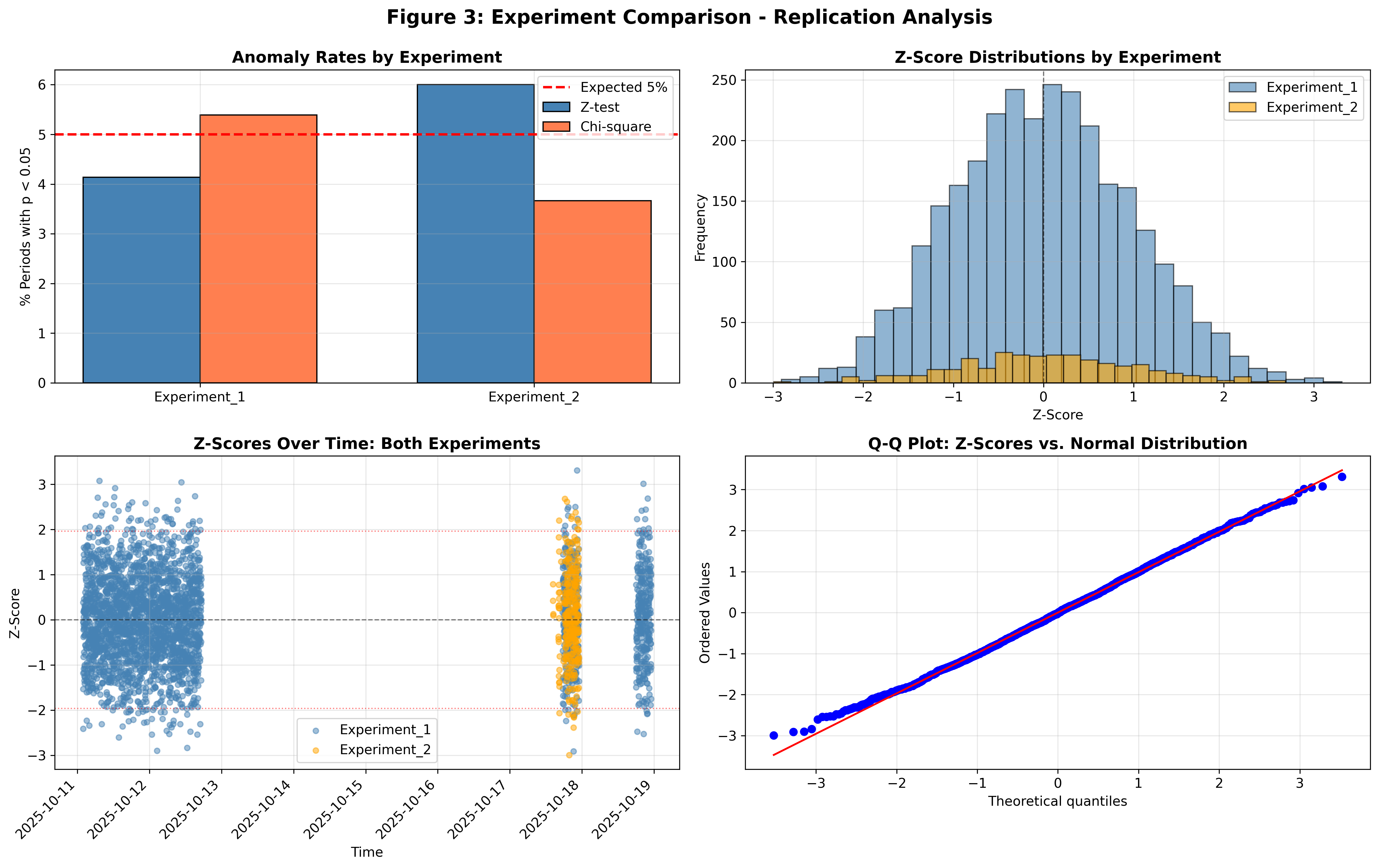
An earlier version of this page reported NYE as the strongest temporal-clustering result in the program -- a significant runs test, lag-1 autocorrelation, Markov burst clustering, spectral cyclicity, and a burst structure that appeared to track documented meditation sessions. That result was a data-duplication artifact and has been withdrawn. The parser that assembled the combined NYE series ingested the same periods twice under two file-naming conventions, double-counting roughly a third of them. Because each duplicate sorted next to its identical twin, every sequential statistic -- runs, autocorrelation, Markov transitions, spectral analysis -- read those adjacencies as structure. It was the perfect false positive for exactly the tests the claim rested on, and it left the aggregate mean almost untouched, which is why the deployment still looked "aggregate-null with temporal structure." That pattern was the bug's signature, not a finding.
Deduplicated (n = 2,823 experimental periods), NYE is temporally null on both units: the runs test lands at z = +0.35, p = 0.73 (previously significant), the spectral test at p = 0.93 (previously flagged), and the aggregate 2σ anomaly rate at 4.53%, p = 0.28. The Markov and autocorrelation numbers ride on the same sequential adjacencies and go null with them. The verbatim pre-correction section is preserved in deprecated/; the corrected series lives in the Ionosphere vault (nye_2025/analysis/v1.1.0-dedup/). The error was checked and is NYE-only -- Autumn Lights, the housewarming session, and the ACORN session data are all unaffected.
What survives NYE is its design, not a signal. Two devices -- same hardware, same building, same window, identical software, one attended and one not -- and after correction both are clean nulls. That makes NYE a well-characterized null control rather than a positive result, which is still worth something: it is the blinded contemporaneous channel the field usually lacks, and it simply showed no effect.
July 4 2026 -- same-machine paired control (the current anchor)
July 4-5, 2026. The strongest artifact-ruling-out design in the program to date: an attended TrueRNG arm driving an on-screen visualizer, and a simultaneous unattended PRNG control running on the same machine, over a shared window of 1,000 sixty-second periods per arm. Same clock, same host, same software path -- the control removes software- and timing-side artifacts in a way the separate-device NYE design could not.
Aggregate is null in both arms (Stouffer Z +0.63 attended, +0.20 control). The result that holds up is a covariate-window burst enrichment: during pre-logged focus-session windows, the attended arm ran an anomalous-burst rate of 10.3% (11 of 107 in-window periods) against 3.9% (35 of 893) outside them -- Fisher exact p = 0.0066, odds ratio 2.81 -- while the PRNG control stayed flat across the same windows (3.7% vs. 3.8%, p = 1.0). The effect lives in the tail, not the mean.
This is exploratory, and stays that way. It was not preregistered; the window tiers were fixed before the contrast was computed but after the run; the field notes were transcribed post-run from contemporaneous phone and Oura records; and roughly eleven counted anomalies carry the result. It does survive the sensitivity checks that were run -- leave-one-window-out, reclassifying the most extreme in-window periods, a circular-shift placement test (p = 0.007), and a seam-free block-permutation test (p = 0.007-0.018) -- with the control arm null on every one. Internally persistent under every perturbation tried, but exploratory by construction: it motivates a sealed, preregistered follow-up, and confirmatory language is reserved for that. It is not a replication of the withdrawn NYE clustering -- that was an artifact, and this window structure is different in kind.
The control matters
The simultaneous unattended-control design is the methodological feature that distinguishes Ionosphere from prior RNG-during-event work, and it is exactly what caught the false positive. Critiques of GCP-style prospective designs often turn on the absence of a synchronous null channel [Bancel & Nelson 2008][Nelson & Bancel 2011]: the experimenter analyzes a network of RNGs against pre-stated event windows, but no comparable RNG was running in identical conditions with no event attached. NYE 2025/2026 built that channel with two blinded devices; July 4 2026 tightened it to a single machine running both arms at once. In the NYE case the two units are now both null after correction, and in the July 4 case the control arm stays flat exactly where the attended arm shows its window enrichment. Neither design manufactured a positive; both did their job, which was to make an artifact falsifiable.
A housewarming party in November 2025 (357 one-minute periods, no dedicated control device) returned null on the battery as well. Across every deployment the aggregate is consistent with true randomness on the mean and rate -- combined fixed-effects z near zero. That aggregate null is not a hidden positive waiting to be teased out; it is the baseline the whole program rests on, and the honest characterization of the corpus is that it is a clean, well-documented null with a couple of exploratory window effects at the edges.
The 12-test battery
No single test captures temporal burst structure. Ionosphere uses a fixed battery applied to every dataset:
- Autocorrelation (lag-1 serial dependence)
- Distribution-shift detection (PELT)
- Spectral analysis for cyclic structure (Fisher test) [Fisher 1929]
- Stouffer's Z (aggregate directional)
- Bootstrap mean Z (CI for mean z-score)
- Entropy test (p-value uniformity)
- Extreme value analysis (tail probability vs. Gaussian)
- Detrended fluctuation analysis [Peng et al. 1994][Peng et al. 1995] -- alpha treated as descriptive only
- Variance ratio (Lo-MacKinlay standardization, trend across lags)
- Markov transition probabilities [Anderson & Goodman 1957]
- Time-of-day analysis (Rayleigh; applied only to runs longer than a day)
- Lag analysis at extended lags
Two entries were revised in the July 2026 audit. The variance-ratio statistic was re-derived to the Lo-MacKinlay standardization after an earlier formula inflated its z-scores corpus-wide; corrected, no variance-ratio result is significant in either arm of any dataset. The time-of-day test was restricted to full-day-plus runs, because a uniform-clock null is not even definable on a sub-24-hour window -- on a short run the test rejects uniformity by construction, and it duly "fired" in an unattended control, which is the tell. Detrended fluctuation analysis is reported as a descriptive exponent only; its inferential p-value comes from an anti-conservative fit and is not cited.
The preregistered follow-up targets the covariate-window burst enrichment -- the one signal that survived -- as its primary outcome, with the full battery retained to characterize the null. The pipeline computes every test per dataset and is ready to scale.
Applied coherence sampling
A separate proof-of-concept used Ionosphere's QRNG stream as a seed source for the Weather Research and Forecasting (WRF) numerical weather model. During the January 2026 North American winter storm, an Ionosphere coherence-sampled seed produced lower quantitative precipitation forecast error than all 20 control seeds and the unperturbed control run, verified against airport observations (p < 0.05). This is preliminary and one storm only -- a single result, not a body of evidence -- but it suggests that whatever structure the seed-selection step is picking up may have downstream usefulness for systems that consume random seeds.
This WRF result predates the July 2026 correction cycle and was not re-examined in it. The winter-storm run also sits outside the main RNG corpus (it is a separate single-operator proof-of-concept, not one of the field-experiment datasets). Treat it as preliminary and unverified pending a dedicated re-audit -- it is kept here as a standing note, not asserted as a confirmed finding.
What this is not
Ionosphere does not claim to demonstrate that consciousness directly causes RNG deviations. What it has, honestly stated, is an aggregate-null corpus with no endogenous temporal clustering, and two exploratory covariate-window burst enrichments -- Autumn Lights' meditator window and July 4's focus windows -- that concentrate anomalous bursts during engagement while a control stays flat. Those are the signals that survived a correction cycle that withdrew a stronger, earlier claim. They motivate a preregistered replication; they do not, on their own, establish an effect.
Mechanisms are not addressed. Whether the effect is best explained by direct mind-matter interaction (the strong reading) [Radin et al. 2012][Mossbridge et al. 2012], by environmental or experimenter-side artifacts that correlate with engagement (a confounding reading), or by selection effects in how engagement windows are chosen -- those questions require multi-site, pre-registered replications with independent analysis pipelines. We are not there yet.
Where Ionosphere connects to broader consciousness theory -- IIT [Albantakis et al. 2023], Global Workspace [Mashour et al. 2020] -- is left open. The data constrain mechanism, they do not yet identify one.
Limitations
- Every window-based result reported here is exploratory and not preregistered. The proposed multi-site replication will preregister the covariate-window burst-enrichment contrast as the primary outcome.
- Single site, single experimenter team. No independent replication.
- An earlier headline of this program -- the NYE temporal-clustering result -- was withdrawn in July 2026 as a data-duplication artifact. It is kept as a cautionary limitation, not erased: a sequential-structure signal that leaves the aggregate untouched is exactly what a duplicated series produces, and that failure mode is now a standing check on the pipeline.
- Detrended fluctuation analysis is reported as a descriptive exponent only; no inferential weight is placed on it, because its p-value is anti-conservative on these series.
- Friday Autumn Lights attended (327 periods) and hidden-control (273 periods) samples were unequal in size. Power is asymmetric across the two devices.
- The surviving window contrasts (Autumn Lights meditator window, July 4 focus windows) rest on contemporaneous field notes, not preregistered windows; the notes were in several cases transcribed post-run, so timestamp provenance alone cannot prove the windows were fixed blind to the summary output. This is a forking-paths caveat, and it is why the language stays exploratory.
- The pattern engine is an unblinded variable. Future designs will run yoked sham-pattern-engine controls to isolate the audiovisual feedback variable from QRNG state.
- Effect sizes are modest and the surviving results are underpowered. The July 4 window enrichment (Fisher exact p = 0.0066, exploratory) rests on roughly eleven counted anomalies; it is the strongest current controlled result, and it is fragile enough that only a preregistered follow-up can settle it.
Team
- -- principal investigator, software development, design, analysis, statistical methods, pattern engine
- Timothy D. Beach -- audio engineer, software development, hardware
- Danielle S. Caputi -- co-investigator, software development, hardware, design
- Justin Iredale -- hardware, exhibition coordination
References
- Albantakis, L., et al. (2023). Integrated information theory (IIT) 4.0. PLOS Computational Biology, 19(10), e1011465. doi:10.1371/journal.pcbi.1011465
- Anderson, T. W., & Goodman, L. A. (1957). Statistical inference about Markov chains. Annals of Mathematical Statistics, 28(1), 89-110. doi:10.1214/aoms/1177707039
- Bancel, P., & Nelson, R. (2008). The GCP event experiment: Design, analytical methods, results. Journal of Scientific Exploration, 22(3), 309-333.
- Fisher, R. A. (1929). Tests of significance in harmonic analysis. Proceedings of the Royal Society of London A, 125(796), 54-59. doi:10.1098/rspa.1929.0151
- Herrero-Collantes, M., & Garcia-Escartin, J. C. (2017). Quantum random number generators. Reviews of Modern Physics, 89(1), 015004. doi:10.1103/RevModPhys.89.015004
- Jahn, R. G., et al. (1997). Correlations of random binary sequences with pre-stated operator intention: A review of a 12-year program. Journal of Scientific Exploration, 11(3), 345-367.
- Mashour, G. A., Roelfsema, P., Changeux, J.-P., & Dehaene, S. (2020). Conscious processing and the global neuronal workspace hypothesis. Neuron, 105(5), 776-798. doi:10.1016/j.neuron.2020.01.026
- Mossbridge, J., Tressoldi, P., & Utts, J. (2012). Predictive physiological anticipation preceding seemingly unpredictable stimuli: A meta-analysis. Frontiers in Psychology, 3, 390. doi:10.3389/fpsyg.2012.00390
- Nelson, R. D., & Bancel, P. A. (2011). Effects of mass consciousness: Changes in random data during global events. Explore, 7(6), 373-383. doi:10.1016/j.explore.2011.08.003
- Peng, C.-K., et al. (1994). Mosaic organization of DNA nucleotides. Physical Review E, 49(2), 1685-1689. doi:10.1103/PhysRevE.49.1685
- Peng, C.-K., Havlin, S., Stanley, H. E., & Goldberger, A. L. (1995). Quantification of scaling exponents and crossover phenomena in nonstationary heartbeat time series. Chaos, 5(1), 82-87. doi:10.1063/1.166141
- Radin, D. I., & Nelson, R. D. (1989). Evidence for consciousness-related anomalies in random physical systems. Foundations of Physics, 19(12), 1499-1514. doi:10.1007/BF00732509
- Radin, D., et al. (2012). Consciousness and the double-slit interference pattern: Six experiments. Physics Essays, 25(2), 157-171. doi:10.4006/0836-1398-25.2.157
See also
- TSC 2026 Corpus Analysis Report (79 runs, SEED=0 physical audit) -- comprehensive_data_analysis.html (mirror on ionospherelabs.com)
- ACORN 2026 abstract (kept as the delivered record, with a 2026-07-08 erratum) -- listed under articles
- Live patterns viewer -- patterns.html